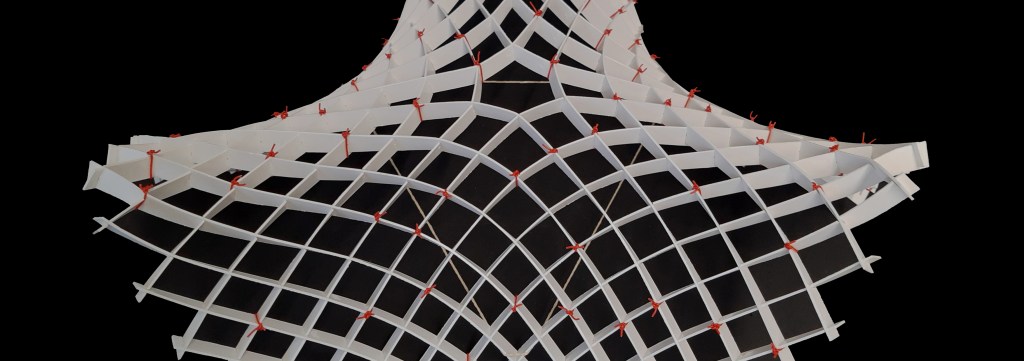
ASYMPTOTIC GRIDSHELL
Anand Shah, August Lehrecke, Cody Tucker, Xiliu Yang
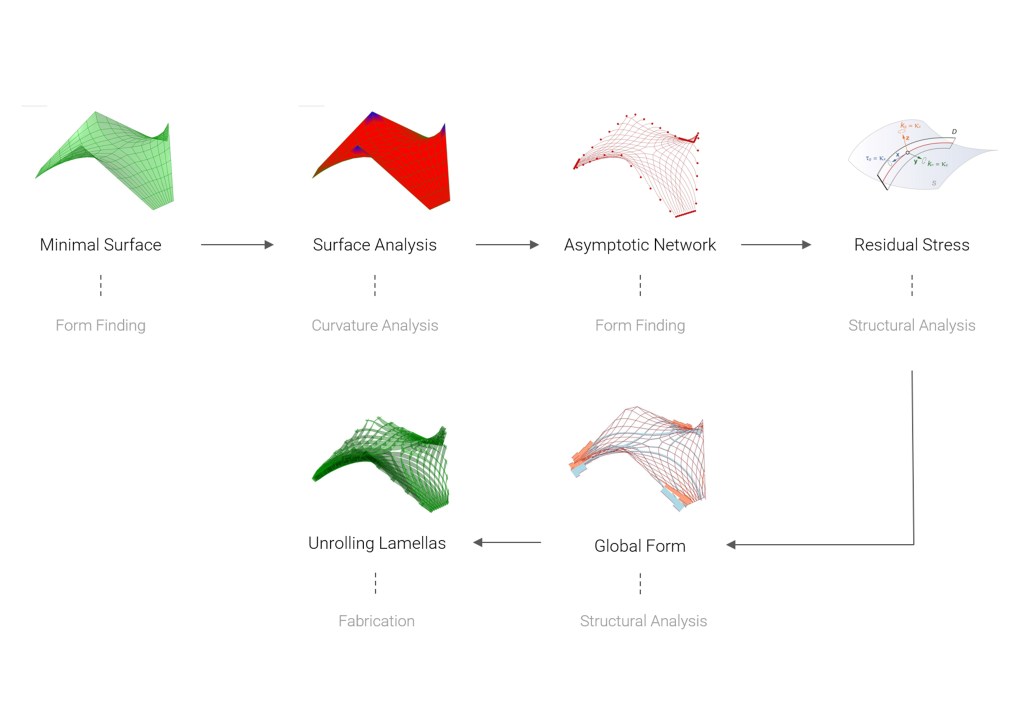
The project was developed as a part of seminar subject, Form and Structure at ITECH course, University of Stuttgart. The project aims to combine insights from differential geometry and structural engineering to explore the design and form finding process of asymptotic gridshells. Asymptotic grid networks can be materialized as bending active lamellas, forming gridshells with negative curvature.
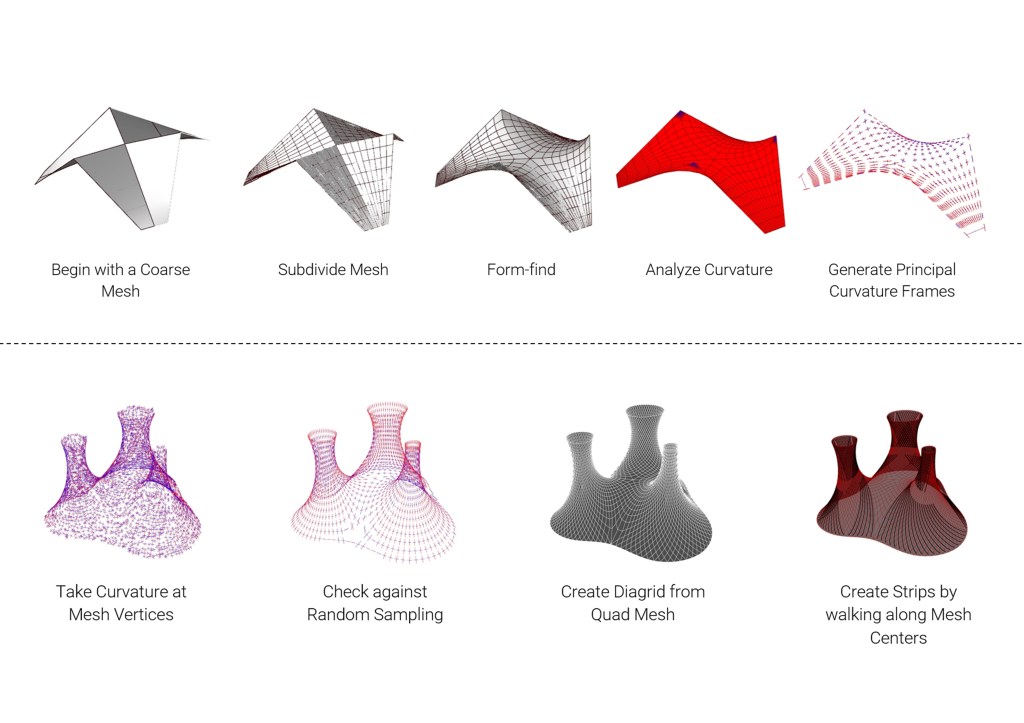
Asymptotic networks exist on surfaces with vanishing normal curvature. This type of network exhibits favorable properties such as straight unrolling (simplifying fabrication), and beam orientation along the surface normal direction (structural performance). Minimal surfaces, as a subset of these surfaces, have the additional favorable property where lamellas in the network can meet at orthogonal angles, simplifying fabrication details.
Residual stresses in the lamellas are calculated using Euler – Bernoulli Equation for Normal Bending Stresses and Saint – Venant Theory for Shear Stresses due to Torsion. Whereas the global structural performance is checked using Finite Element Analysis.
Unfortunately, the structural performance of these gridshells came out to be very ordinary. The main reason behind that is, the beam elements being oriented perpendicular to the principal stress lines. Apart from the structural performance, several geometrical challenges were faced while generating the asymptotic network. The procedures required to generate asymptotic lines rely on the continuous nature of parametric surfaces. Most form-finding and relaxation tools only output meshes, which are discrete and can only provide approximations of these asymptotic networks. An equally challenging aspect of designing asymptotic gridshells is how much points through which these networks are plotted affect the final design outcome. Asymmetrical surfaces produce uneven distribution of this network, which results in tricky edge conditions. In addition, the surface produces “singularities” in certain areas of the network, which are also hard to predict and design around.


 Anand Shah